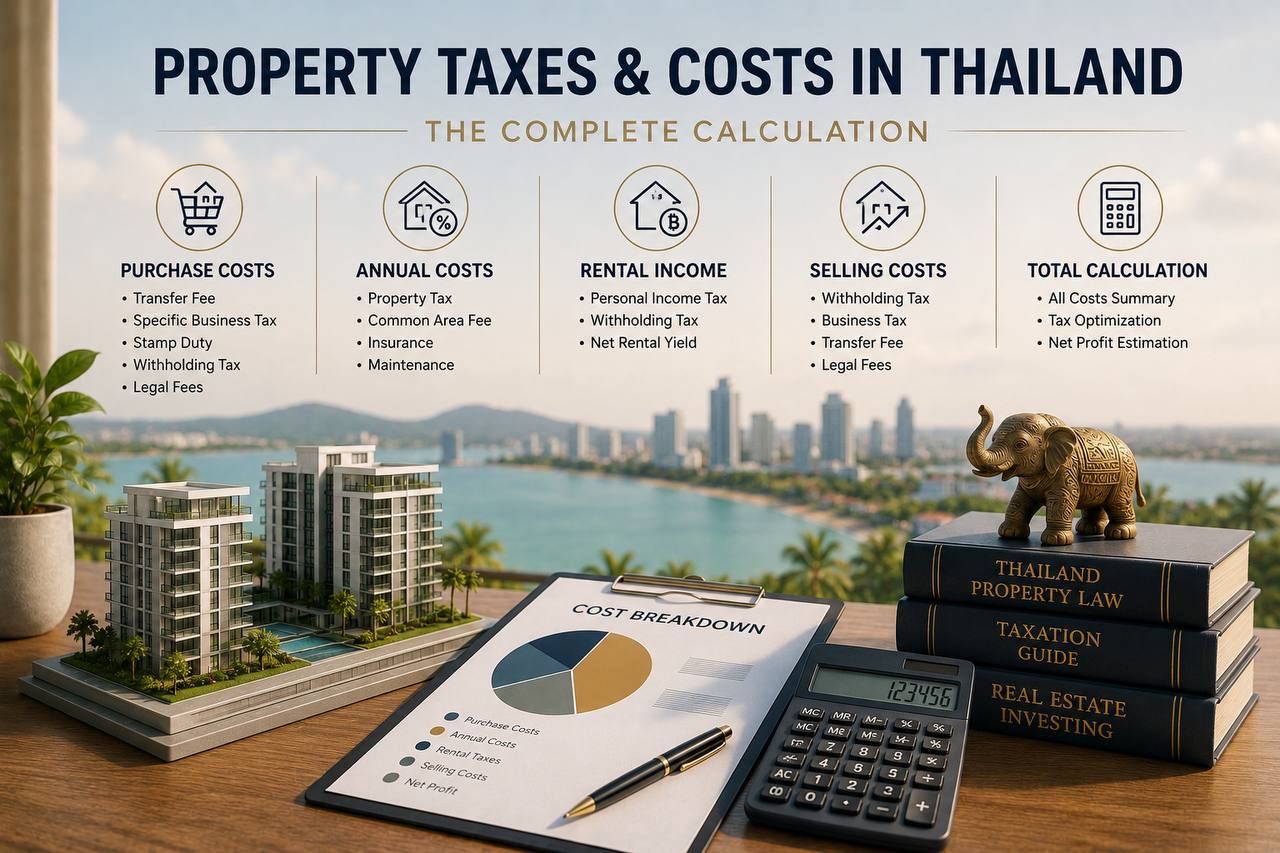
Short answer: one-off transaction costs run 2.5–6.3% of the price (depending on how you split payments with the seller), the annual holding tax on a typical condo is a token few hundred to few thousand baht — and the real "hidden" money sits not in taxes but in condo fees and in the foreign remittance tax rule most buyers discover too late. Here is every payment across the life of a property — buying → owning → renting out → selling — at the rates in force in 2026.
All Thailand Property Taxes at a Glance
When | What you pay | How much |
Once, at purchase | Transfer fee / leasehold registration; seller's taxes often priced in | 2% / 1.1%; total deal costs 2.5–6.3% depending on negotiation |
Every year | Land & Building Tax + condo fees (CAM) | Tax from 0.02% of appraised value; CAM ~THB 40–80/m²/month |
When renting out | Income tax on rental income | Residents: 5–35% progressive; non-residents: 15% withholding |
When selling | Same transfer fee + SBT/stamp + withholding — now on your side | 2% + 3.3% (or 0.5%) + WHT |
Each block in detail below, with baht examples.
One-off costs when buying
Registration math runs off the official appraised (government) value, which usually sits below market price. The full list:
Payment | Rate | Who pays / notes |
Transfer fee | 2% of the official appraised value | Custom: 50/50 buyer-seller, but everything is negotiable |
Leasehold registration (instead of transfer fee) | 1.1% of total lease value | Usually the buyer |
Specific Business Tax (SBT) | 3.3% of the higher of sale/appraised price | Seller; only if owned under 5 years (or not house-registered 1+ year) |
Stamp duty | 0.5% | Seller; replaces SBT after 5+ years of ownership |
Withholding tax | Individuals: formula on appraised value factoring years owned; companies: 1% | Seller; in practice usually ~1–3% of appraisal for individuals |
What it looks like in money. A resale condo: price THB 5M, appraised value THB 4.5M, individual seller owned 3 years, not house-registered. Transfer fee 2% of 4.5M = THB 90,000 (THB 45,000 each on a 50/50 split); SBT 3.3% of 5M = THB 165,000 — the seller's; the seller's withholding, by formula — roughly another THB 50,000–90,000. On an honest 50/50 the buyer pays ~THB 45,000 in fees (0.9% of price) plus legal costs. But:
"Who pays" is always a negotiation. The law pins only the seller's taxes on the seller; the transfer fee splits by agreement. The market runs the full range — from "each pays their own" to "everything 50/50 including the seller's taxes," which quietly adds 1.5–2% to your cost. Fix the allocation in the contract, in writing, before the deposit moves.
Sellers' taxes are often already priced in — especially in new builds and with flipping investors. That's fine — just don't agree to pay them again on top.
The 0.01% stimulus is not for you. The reduced transfer fee (0.01% for homes up to THB 7M, extended to 30 June 2027) applies only to Thai-national buyers. Foreigners pay the standard 2% at any price point.
The mechanics of the deal itself — who pays what, when and where — step by step: Buying Property in Thailand: The Step-by-Step Process And what you can legally own in the first place: Thailand Property Ownership for Foreigners
Annual costs: Land & Building Tax + condo fees
Since 2020 Thailand levies a single annual Land & Building Tax. What matters in 2026: the pandemic-era discounts are over — the tax was cut by 90% in 2020–2021, relief was phased down, and 2026 is the first full-rate year with no across-the-board reduction. If you've owned for years and budget from old bills, expect an increase. The 2026 payment deadline is extended to June; bills from THB 3,000 can be paid in three installments.
Residential category | Rate (of appraised value) | Notes |
Primary home: land + house, owner in the house register | 0.03–0.10% above a THB 50M exemption | Zero for most owner-occupiers |
Primary home: building only (house on leased land) | 0.02–0.10% above a THB 10M exemption | The typical foreign villa structure |
Other residential (investor condos, second homes, rentals) | 0.02% up to THB 50M; then 0.03–0.10% | The typical foreign condo owner's case |
Vacant land | from 0.30%, +0.30 pp every 3 idle years (3% cap) | Relevant to land holders |
In money terms it's small. A condo appraised at THB 5M in the "other residential" band: 5,000,000 × 0.02% = THB 1,000 a year. A villa structure (owned house on leased land, primary residence) appraised under THB 10M — zero. The tax is paid to the local administration; late payment draws fines and surcharges, and unpaid tax blocks a future transfer.
Beware of outdated articles: the old House & Land Tax at 12.5% of rental value was abolished back in 2020. Any source quoting "12.5% annually" is dead.
The real annual line item isn't tax — it's condo fees: CAM fees (common area maintenance) typically run THB 40–80/m²/month in Phuket — THB 24,000–48,000 a year for a 50 m² unit. Plus a one-time sinking fund contribution on new builds, usually THB 400–800/m². Budget these first.
Tax when renting out
Rental income from Thai property is taxable in Thailand regardless of where you live. Resident individuals pay the progressive 5–35% scale (with a deduction: a standard 30% of income for expenses, or actual documented costs). For non-residents, the tenant or agent must withhold 15% at source; the withholding can be reconciled by filing a Thai return — the scale outcome often comes in below 15%. The full rental economics — yields, occupancy, management — get their own article: Phuket Property Rental Yields
Taxes when you eventually sell
Selling puts you on the other side of the same table: the 2% transfer fee (negotiated with your buyer), SBT at 3.3% if you owned under 5 years (0.5% stamp duty after), and withholding computed on the appraised value factoring years of ownership. Plus the practical point to think about at purchase time: to repatriate sale proceeds freely, your bank will ask for proof the funds originally entered Thailand legally — the FET certificate and transfer confirmations. Keep them for the entire holding period.
Is the money you transfer for a purchase taxed? The rule everyone fears
From 1 January 2024 Thailand changed how it taxes foreign-sourced income, spawning the buyer's biggest fear: "I'll wire money for a condo and owe up to 35%." Here's what actually applies in 2026:
The rule touches tax residents only. A resident is anyone spending 180+ days in Thailand in a calendar year. If you're not a resident in the year of the transfer (the classic case: buying remotely, or relocating later) — no Thai tax arises on your remittance at all.
Income is taxed — not money as such. Tax arises when a resident remits foreign income (salary, dividends, gains) earned from 2024 onward. Capital and savings accumulated before 1 January 2024 are exempt — but the exemption must be provable: statements documenting the source and date of every part of the remittance.
A relief is discussed — not enacted. A draft would exempt income remitted in the year it's earned or the following year; the Revenue Department has announced it, but as of mid-2026 it is not formally in force. Don't structure a purchase around a future concession.
The buyer's practical playbook: (1) if possible, remit in a year you're not a Thai tax resident; (2) remit from pre-2024 capital and keep source documents; (3) certain LTR visa categories carry a foreign-income exemption; (4) on large sums, a Thai tax advisor costs less than a mistake. This article is editorial guidance, not tax advice.
If your country has a double taxation agreement with Thailand, tax paid in one jurisdiction is generally creditable in the other — check your treaty's terms.
FAQ
What taxes does a buyer pay on a condo in Thailand?
The main item is the 2% transfer fee on the appraised value, customarily split with the seller (so ~1% for the buyer), or 1.1% for leasehold registration. The seller's taxes (SBT 3.3% or 0.5% stamp duty, plus withholding) are legally theirs but often priced in. All-in, a deal costs 2.5–6.3% on top of the price depending on the split.
Is there an annual property tax in Thailand?
Yes — the Land & Building Tax. For a typical foreign-owned condo the rate starts at 0.02% of appraised value: about THB 1,000 a year on a THB 5M condo. From 2026 full statutory rates apply, with pandemic discounts expired. The bigger annual cost is condo CAM fees, not the tax.
How is rental income taxed in Thailand?
Thai-source rental income is taxed in Thailand: residents at the progressive 5–35% scale with an expense deduction (standard 30%), non-residents via a 15% withholding at source, reconcilable through a Thai tax return.
Is transferring money to Thailand to buy property taxable?
Not if you're not a Thai tax resident in the year of transfer (under 180 days in the country). For residents, foreign income earned from 2024 onward is taxable when remitted; pre-2024 capital is exempt with proof of source. The discussed relief (remittance in the earning year or the next) is not formally enacted as of 2026.
Do foreigners get the 0.01% transfer fee?
No. The reduced 0.01% fee (homes up to THB 7M, extended to 30 June 2027) is exclusive to Thai-national buyers. Foreign buyers pay the standard 2%.
Which is cheaper on taxes — freehold or leasehold?
Registering a leasehold costs 1.1% of the lease value versus the 2% transfer fee — cheaper at entry. Ongoing annual taxes are comparable and small either way. Choose the ownership form on legal grounds, not for the fee difference: it's secondary.