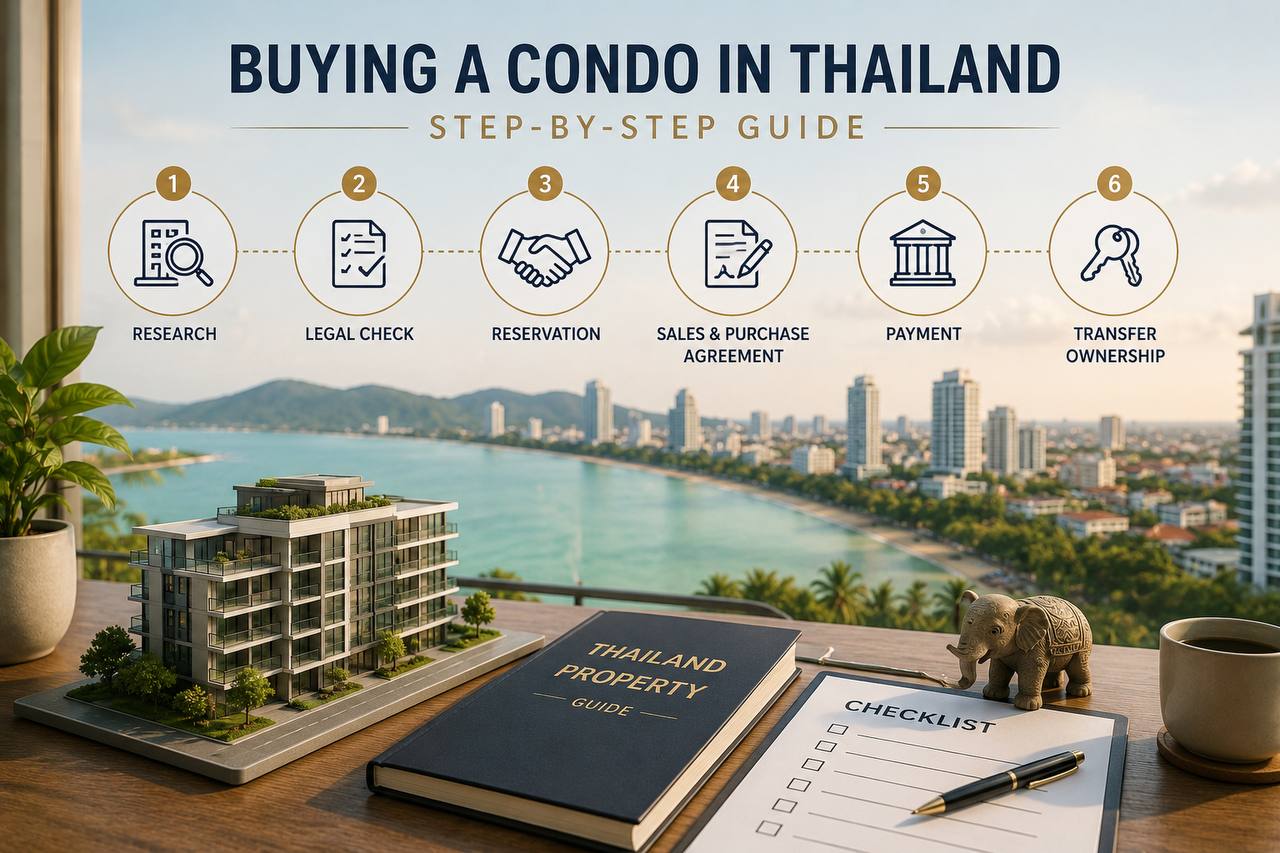
A property purchase in Thailand takes two weeks to two months and runs through six stages: due diligence → reservation → contract → transferring funds from abroad → payment → registration at the Land Department. There is no notary in the Western sense — the registry is kept by the government's Land Department, and the buyer's real protection happens before money moves, not after. Here is every step: what to verify, what to sign, how to pay, and what you walk away holding.
This guide covers the mechanics of the deal. What foreigners can legally own in the first place — freehold condos, the 49% quota, leasehold structures — is covered separately: Thailand Property Ownership for Foreigners
How to Buy a Condo in Thailand: All Steps at a Glance
Due diligence: condominium status, available foreign quota, title deed, encumbrances, the developer.
Reservation: a THB 50,000–200,000 deposit under a reservation agreement.
Sale and purchase agreement: SPA signing with a 10–30% contract payment.
Transfer funds from abroad in foreign currency, obtaining the FET certificate.
Payment: scheduled installments (off-plan) or full settlement on deal day (resale).
Registration at the Land Department: fees paid, transfer entered in the registry, title deed received.
Now each step in detail — amounts, timelines, and what to verify.
Step 0. Two decisions before you start searching
Ownership form. A freehold condo within the foreign quota, a leasehold, or a villa structure — this shapes both your budget and your due diligence list. Undecided? Start with the ownership guide above.
Total budget, not sticker price. On top of the price come transfer taxes and fees (typically 1.5–4% on the buyer's side depending on what's negotiated — full table below), legal support (THB 30,000–80,000 for full due diligence) and international transfer costs.
Step 1. Due diligence: before the money, not after
Thailand has no notary who guarantees a clean transaction and no title insurance industry. The filter is the due diligence you commission. For a condo it covers:
The building's legal status. Foreign freehold exists only in buildings registered as condominiums under the Condominium Act. "Apartments" and apart-hotels don't qualify. Verified against the Land Department registry.
The foreign quota. Whether the 49% share in this specific building is still available — confirmed with the condominium juristic person. No quota, no freehold.
The land title under the project. The strongest deed is the Chanote (NS-4): surveyed boundaries, full rights. Villas sometimes sit on Nor Sor 3 Gor — workable but less precise; anything weaker is a reason to walk. A completed condo unit carries its own unit title deed, which is what you'll receive.
Encumbrances. A Land Department search: mortgages, seizures, servitudes, third-party rights.
Building debts. For resales — a debt-free letter from the building management confirming no outstanding fees; the Land Department won't register the transfer without it.
The developer — for off-plan. Track record, completed projects, land rights, construction permit, EIA environmental approval for larger projects. The full checklist: How to Vet a Developer in Thailand
Step 2. Reservation: the rules changed in 2025
A reservation agreement and deposit take the unit off the market — typically THB 50,000–200,000 (or 1–2% on higher-priced properties). Since 31 January 2025, developers' reservation contracts are a controlled contract under Thailand's Office of the Consumer Protection Board (OCPB), which materially strengthened the buyer's hand:
Reservations follow a standardized Thai-language form in two identical copies — one must stay with you. Get a translation before signing.
Unfair clauses — like "the deposit is non-refundable under any circumstances" — are banned.
Where a refund is due, deadlines are fixed: 15 days for bank transfers, 45 days for card payments.
Reservation money may only be used to secure your unit, with receipts for every payment.
Note: OCPB rules protect you when buying from a developer. In a private resale, refund terms are whatever the reservation agreement says — read it before paying, and make sure the deposit's return on the seller's default is spelled out.
Step 3. The sale and purchase agreement
After reservation and due diligence comes the main contract (for off-plan, the SPA — usually within 14–30 days of reserving). Non-negotiable checks:
Exact unit description — number, area, floor — and the price adjustment mechanism if the surveyed area differs.
The payment schedule and each side's consequences for default.
For off-plan: the completion deadline, delay compensation (market standard: a monthly penalty and a termination-with-refund right after prolonged delay), and structural/finishing warranties.
The ownership form stated explicitly — freehold or leasehold; if leasehold, every lease term including succession to heirs.
Who pays which fees at registration — it's negotiable, so fix it in writing.
Bilingual Thai/English contracts are standard; if versions conflict, the Thai text usually prevails — which is why legal review happens before signing, not after.
Step 4. Transferring funds and the FET certificate
To register foreign ownership, your money must reach Thailand from abroad, in foreign currency (conversion to baht happens at the receiving Thai bank). For amounts from USD 50,000 the bank issues a Foreign Exchange Transaction (FET) certificate — the document the Land Department will demand at registration. Technical rules that save weeks:
State the purpose in the transfer: "purchase of condominium unit No. …, project …" plus the buyer's name — exactly as it will appear on the title.
Sender and buyer should ideally be the same person; third-party payments need advance clearance with your lawyer and the bank.
Send a buffer for FX and fees: being short on registration day kills the appointment.
Keep every SWIFT confirmation — you'll need them again to repatriate proceeds when you eventually sell.
With installments, the rule applies to every tranche. Each scheduled payment must arrive from abroad with the correct purpose stated — confirmations are collected per transfer, and at registration the Land Department will want to see the full amount came from overseas. Tranches paid "whichever way was convenient" — from a Thai account, in cash, from a third party — create a problem that's expensive to fix later.
Step 5. Payment: installments vs same-day settlement
Off-plan: staged payments. The typical split: the reservation fee credits toward a contract payment of 10–30% at SPA signing → construction-period installments → a 20–30% balance at handover. Developer installment plans are interest-free — that's market standard, not a gift (paying 100% upfront earns a 3–7% discount, but it also puts your entire outlay at unsecured risk).
Check what the schedule is tied to. Payments are linked either to the calendar ("10% every three months") or to construction milestones (foundation, structure, building envelope). Milestone-based schedules are safer for the buyer: you pay for verified progress. On a calendar schedule, construction can stall while your payments keep running.
The balance comes after inspection, not before. Before the final payment you inspect the unit, a defect list is drawn up, the developer fixes it — and only then is the balance paid and handover signed. Verify in the SPA that the balance is tied to defect rectification, not to a "notice of readiness" — developers' favorite wording.
Escrow accounts exist in Thailand but are not mandatory by law — buyer installments are not automatically protected, and everything you pay before handover is effectively an unsecured loan to the developer. A project running payments through licensed escrow is objectively safer; without escrow, your only insurance is the quality of the developer and the contract.
Resale: full settlement happens on registration day at the Land Department, classically by a Thai bank cashier's cheque handed to the seller as the transfer is signed. This money-against-title mechanism is what makes resale settlements safe.
Step 6. Registration at the Land Department: deal day
The finale is a visit to the Land Department office for the property's district — in person or by proxy. Both sides (or their representatives) file documents, government fees are paid, and the registrar records the transfer — normally the same day. A foreign buyer brings:
Passport (and a notarized Thai-language power of attorney if a representative acts for you).
The FET certificate from the bank.
For freehold condos: the juristic person's letter confirming the foreign quota and the debt-free letter.
What you receive: the unit title deed with your name entered on the back (freehold condo), or the registered lease bearing the Department's endorsement (leasehold), plus the Department's official sale agreement. For a villa — the land Chanote with the lease registered on it and the documents for the structure. From that moment you're the owner of record — the registry is public and verifiable at any time.
Off-plan vs resale: how the deals differ
Stage | Off-plan (new build) | Resale |
Payment | Installments tied to construction: reservation → contract payment 10–30% → stage payments → balance at handover | Reservation → full settlement on registration day (typically by cashier's cheque) |
Main risk | The developer: delays, quality, insolvency | Legal cleanliness: encumbrances, building debts, seller's mortgage |
Key check | Developer track record, permits incl. EIA environmental approval, land rights | Title deed, encumbrance search, debt-free letter from the building management, quota |
Title registration | After completion and handover — often months after full payment | On deal day at the Land Department |
Money protection | OCPB reservation rules + escrow where the project uses it | Money-against-title settlement on registration day |
Timeline and the full cost list
Timeline: a resale with funds ready and a clean title — 2–4 weeks from reservation to registration; off-plan — the contract signs within weeks, but title registers after completion, meaning months or years of scheduled payments first.
Payment | Rate | Who pays (market custom) |
Ownership transfer fee | 2% of the official appraised value | Split 50/50 or as negotiated |
Leasehold registration (if leasing) | 1.1% of the total lease value | Usually the buyer; negotiable |
Specific Business Tax (SBT) — seller owned < 5 years | 3.3% of the higher of sale/appraised price | Seller |
Stamp duty — instead of SBT if owned 5+ years | 0.5% | Seller |
Withholding tax | Individuals: progressive scale on appraised value; companies: 1% | Seller |
About the "0.01% transfer fee" in the news: Thailand did cut transfer and mortgage registration fees to 0.01% for homes up to THB 7 million and extended the measure to 30 June 2027 — but it applies only to Thai-national buyers. Foreigners pay the standard 2%. If a seller has "priced in the discount" on your deal — recalculate.
The tax side — SBT, stamp duty, the seller's withholding tax and how they end up in your price — with worked examples: Taxes and Costs When Buying Property in Thailand
Can the whole process be done remotely?
Yes — a Thai purchase is fully executable without flying in: a lawyer runs due diligence, reservation and contracts sign remotely, funds move by international transfer, and a proxy represents you at the Land Department under a notarized power of attorney (a PoA issued abroad needs notarization and legalization). The full playbook for a safe remote purchase: How to Buy Property in Thailand Remotely
On DealsGrid, most buyers complete the early stages remotely: online viewings, verified agents and developers, and the ownership form stated on every listing: browse Phuket property
FAQ
How long does buying a condo in Thailand take?
A resale usually takes 2–4 weeks from reservation to registration if funds are ready and due diligence is clean. Off-plan contracts sign quickly, but title registers only after completion — payments run on schedule for months or years first.
Is there a notary in a Thai property purchase?
Not in the Western sense. Transfers are registered by the government's Land Department. The buyer-protection function is performed by legal due diligence commissioned before any money moves.
How big is the reservation deposit — and is it refundable?
Typically THB 50,000–200,000. Buying from a developer, OCPB rules apply since 2025: a standardized contract form, a ban on blanket non-refundable clauses, and fixed refund deadlines — 15 days for bank transfers, 45 for cards. In private resales, refundability is whatever the contract says — check before paying.
What is the FET certificate and why do I need it?
The Foreign Exchange Transaction certificate is a Thai bank's confirmation that your purchase funds arrived from abroad in foreign currency; it's issued for amounts from USD 50,000. Without it, the Land Department will not register freehold ownership for a foreigner.
Is my money protected when buying off-plan?
Partially. Developers' reservation payments are regulated by the OCPB, but escrow is optional in Thailand — construction installments aren't automatically protected by law. Prefer projects with licensed escrow, or compensate with deep developer due diligence and strong contract terms.
What costs does the buyer pay at transfer?
The core item is the 2% transfer fee on the appraised value (split with the seller by negotiation), or 1.1% for registering a leasehold, plus legal fees and bank charges. The seller's taxes (SBT 3.3% or 0.5% stamp duty, plus withholding tax) are legally theirs but often get priced in — fix the allocation in writing.