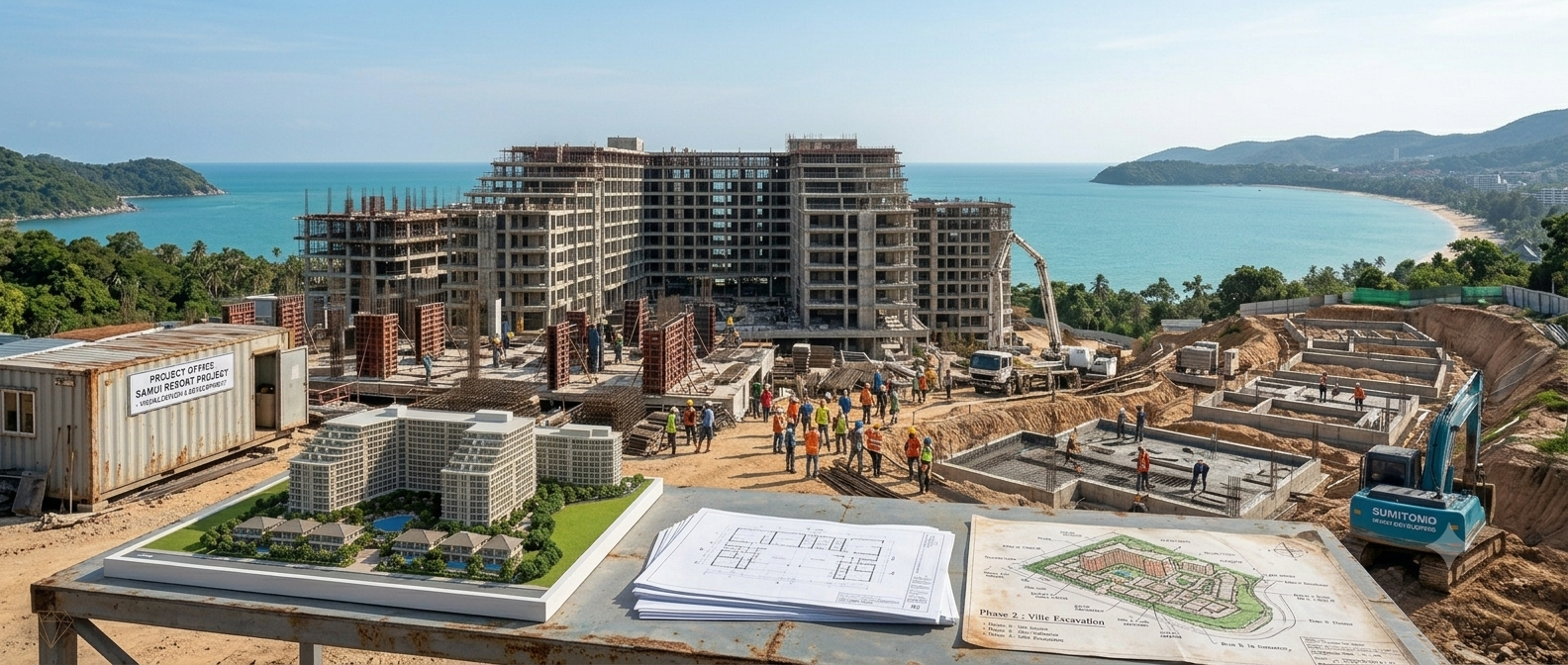
Short answer: vetting the developer in Thailand is the buyer's job, because there is no automatic off-plan protection: escrow accounts are voluntary, and money paid before handover is guaranteed by nothing except the quality of your checks. The minimum set: the entity and its filings in the DBD registry, land title and encumbrances at the Land Department, the building permit, an approved EIA (mandatory for condos from ~80 units or 4,000 m²), litigation history, an OCPB-compliant contract and a payment schedule tied to construction milestones. Below are all ten steps in order, with a document table, the red flags, and an honest look at what actually protects an off-plan buyer in Thailand — versus what merely looks like protection.
Why the Checking Is Your Job, Not the State's
Thailand has no equivalent of Western off-plan safeguards — no mandatory construction-account supervision, no deposit insurance, no automatic escrow, no NHBC-style warranty scheme. An Escrow Act has existed since 2008, but its use is voluntary — in practice most projects sell without it, and buyers' installments fund construction directly. State protection is targeted, not systemic: the OCPB rules in force since 31 January 2025 made developer reservation contracts controlled (bans on "non-refundable under any circumstances" deposits; refunds within 15 days to a bank account, 45 to a card), and the Condominium Act frames the product itself. But months of payments sit between the deposit and the keys — and only your due diligence covers that stretch. The full transaction mechanics: the step-by-step buying process.
Step 1. The Entity: Who Is Actually Selling to You
Nearly every Thai project sits in its own project company (SPV) — normal worldwide practice, not a flag in itself. The flags come next. Request the registration details and check the company in the Department of Business Development (DBD) registry: incorporation date, registered and paid-up capital, directors and shareholders, annual filings. Then look at the group: behind a THB 1M-capital SPV there must stand a parent structure with assets and history — that is who finishes the building when the SPV runs out of money. A mismatch between the entity in the marketing, the contract and the building permit is reason to stop. The practical mechanics: the DBD registry is online, but the interface and extracts are in Thai; the easiest route for a foreigner is pulling the extract and annual filings through a lawyer or a Thai company-check service — a one-day, small-money task. And the very first request to make, even earlier: ask the developer for their ready due-diligence pack (registry extract, Chanote, permit, EIA). Established players have it assembled and hand it over within a day; refusal or weeks of "approvals" is a diagnosis in itself.
Step 2. The Land: Chanote and Encumbrances
Every project stands on a land title. Request the Chanote copy (Nor Sor 4 Jor — the highest Thai title) and have a lawyer pull the Land Department extract: owner, area, encumbrances. The testable logic is simple: the land must belong to the same entity that signs your contract. A bank mortgage securing the construction loan is normal — but it must be disclosed, and the contract must spell out how the mortgage is released from your unit at transfer. What foreigners can own at all, and why the 49% quota matters for condos: property ownership rights in Thailand.
Step 3. Permits: Construction and Environmental
The building permit must be issued to the current entity for the current parameters: floors, area, unit count. Cross-check against what the brochure sells you — a mismatch means either a future redesign or unpermitted work.
The EIA — environmental impact assessment — is mandatory for condominiums from roughly 80 units or 4,000 m² of gross area, and for projects in protected coastal zones. The timing is the point: approval must exist before construction starts. Selling while "the EIA is under review" is legal — and shifts the risk to you: a rejection or forced redesign means delays or changes to a product you have already paid for.
Phuket specifically: the island enforces zoning height limits, strict coastal-strip height caps and a construction ban above 80 m of elevation. Projects marketed on "the best view of the island" should be checked against exactly these rules — demolition stories on Thai hillsides are real.
Step 4. Track Record: the One Guarantee That Can't Be Faked
Delivered projects are the developer's main asset and your main source of truth. Check physics, not renders: visit the completed buildings, look at the common areas after 3–5 years of operation, talk to owners (residents' chats are easy to find) about delivery dates, finish quality and the developer's behavior after handover. A separate indicator is the resale market of their past projects: if units trade at a discount to the neighbors, the market has already issued its verdict. Compare past phases' actual delivery dates with what their own old brochures promised — the internet archive remembers everything.
Step 5. The Money: Escrow or Milestones
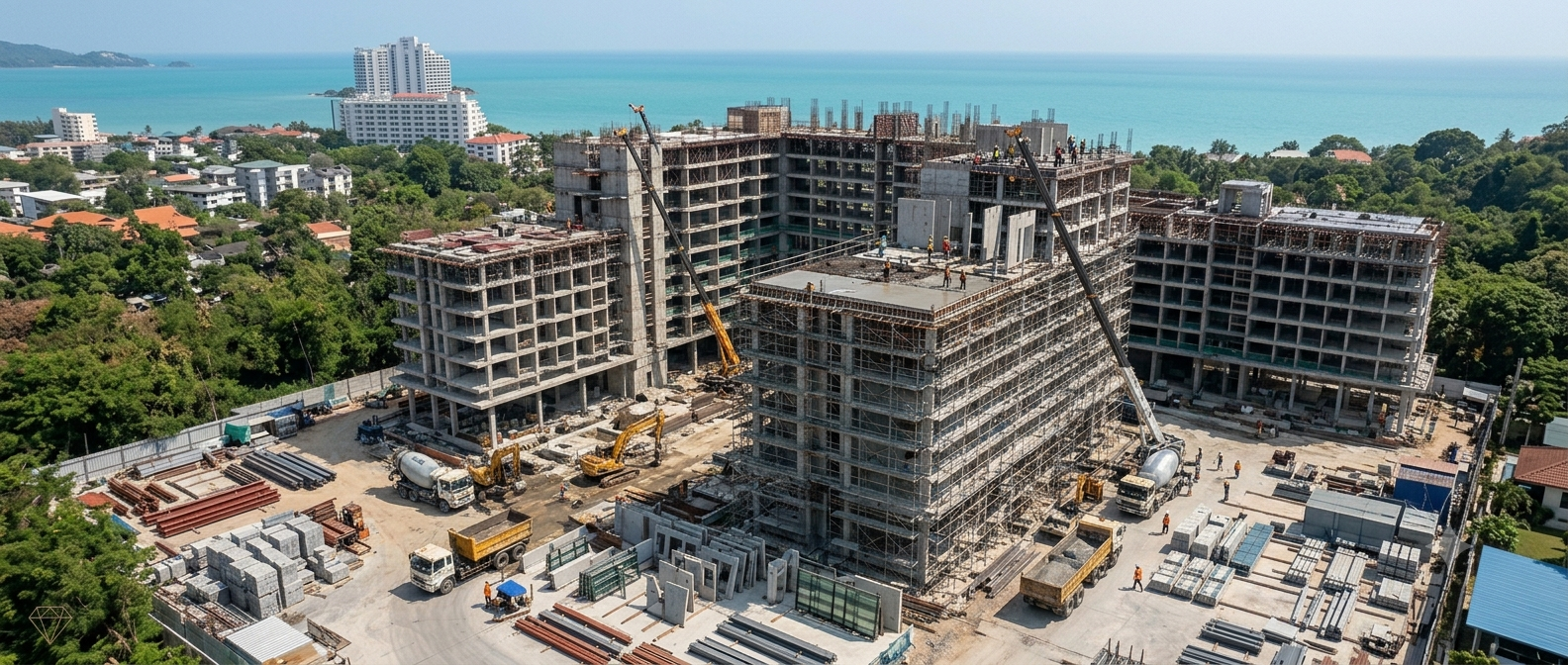
The standard off-plan payment plan is a reservation fee, a 10–30% contract payment and installments to handover. There is only one question: what happens to your money before the keys. The ideal answer is a licensed escrow agent under the Escrow Act, releasing funds against verified stages. Such projects are a minority — which itself is a quality filter. Without escrow, insist on a schedule tied to physical construction milestones (foundation, structure, façade) rather than the calendar, plus the right to pause payments if construction falls behind. A 50%+ payment at groundbreaking with no escrow isn't a purchase — it's an unsecured loan to the developer.
Step 6. Contracts: an OCPB Reservation and a Lawyer-Read SPA
The reservation contract. Since 31 January 2025, developer reservation contracts are controlled: a mandatory standard form, a ban on "non-refundable under any circumstances" clauses, refunds within 15/45 days. If you're handed "our own form" with a non-refundable deposit, the developer either doesn't know the law or ignores it — both are diagnostic.
The sale and purchase agreement (SPA). Read only by an independent lawyer — not the developer's and not "the agent's lawyer". The critical clauses: penalty interest for late delivery and your exit with a full refund beyond an agreed delay threshold; fixed finish and materials specifications; the foreign-quota exhaustion scenario (your money back — not "we'll convert you to leasehold at our discretion"); the snagging and defect-remedy procedure; warranty periods for structure and systems.
Step 7. Litigation and Insolvency
Your lawyer checks court claims against the company and its principals, plus enforcement proceedings via the Legal Execution Department. Isolated commercial disputes are life; systemic buyer lawsuits over past projects, asset seizures or insolvency procedures in the group are a stop signal regardless of how good the renders look.
Step 8. For Villas: Land, Zoning and a Clean Structure
Villa projects need harder vetting than condos: there is no Condominium Act framing them. Beyond title and permits, check the plot's zoning (is it even a residential zone), water and power sources (an estate on "temporary" connections is a chronic Thai story), and — critical after the 2025 nominee crackdown — the cleanliness of the seller's structure: if the estate's land sits in a company with proxy Thai shareholders, that structure's risks become yours. The legal villa architecture (house ownership + registered land lease + superficies) is covered in the ownership guide linked above — demand a written explanation for any deviation from it.
Step 9. Operations: Who Runs the Building After Handover
Half the cost of ownership is decided after completion: who the management company is (the developer's structure or an independent operator), what CAM budget is set (a Phuket benchmark of THB 40–80/m²/month) and whether it's artificially lowballed to help sales — an underpriced CAM means degrading common areas by year three, rising fees, or both. Check the sinking fund size, the handover procedure to the condominium juristic person, and how the developer behaves in its delivered buildings: does it keep control of the juristic person, how are budgets voted.
Step 10. The Market Test of Price and Promises
The final filter is the market. A price per square meter far below comparable neighbors isn't a gift — it's a "why"; a "guaranteed yield" above market norms is funded from your own price: the mechanics are unpacked in the real yields breakdown, and the location context in the Phuket areas guide. Calibrate against live supply: Phuket new developments and the full market — an hour in the catalog calibrates expectations better than any sales manager.
What the Check Costs and How Long It Takes
A full legal check (title and encumbrances, the entity, permits, litigation, contract review) by an independent Thai lawyer typically takes 1–2 weeks and costs in the order of THB 30–60K depending on scope and whether it's a condo or a villa structure — a fraction of a percent of the unit price. The do-it-yourself part (the DBD extract, visits to delivered projects, cross-checking the developer's DD pack) runs in parallel over the same days at zero cost. Schedule the check before the deposit: the OCPB rules protect the refund, but not your weeks and nerves.
Summary Table: the Documents and Where to Check Them
What to verify | Where / how | What good looks like |
The developer entity | Department of Business Development (DBD) registry: extract + annual filings | Active registration; transparent shareholders; a project SPV backed by a parent group with a track record |
Land title | Land Department: Chanote copy (Nor Sor 4 Jor) + encumbrance search | Land owned by the same entity that signs your contract; a construction-loan mortgage is normal but must be disclosed, with a release mechanism for your unit at transfer |
Building permit | Copy from the developer; cross-check with the local administration | Issued to the current entity for the current project; parameters match what's being sold |
Environmental approval (EIA) | Copy of the approved report; mandatory for condos from ~80 units or 4,000 m² | Approved BEFORE construction starts; "EIA under review" during active sales shifts the risk to you |
Litigation history | Court claims against the company and principals; Legal Execution Department (insolvency) | No systemic buyer lawsuits and no enforcement proceedings |
Contracts (reservation + SPA) | Independent lawyer; developer reservation contracts are OCPB-controlled since 31 Jan 2025 | 15/45-day deposit refunds per OCPB; SPA covers delay penalties, specifications, and the quota-exhaustion scenario |
Payment structure | Contract + the 2008 Escrow Act (escrow is voluntary) | Either a licensed escrow agent, or payments strictly tied to construction milestones |
The table is the working minimum. The full check — title, encumbrances, litigation, contracts — is done by an independent Thai lawyer; the fee is a fraction of a percent of the unit price and the cheapest insurance in this deal.
Red Flags: When to Walk Away
The developer can't produce the basic document pack (registry extract, Chanote, permit, EIA) within a few days.
Sales are running while the EIA is "under review" or the building permit is "being processed".
The entity in the contract doesn't match the landowner or the permit holder.
A reservation contract with a non-refundable deposit — a direct breach of the 2025 OCPB rules.
A demand for 50%+ payment at an early stage with no escrow and no milestone linkage.
A "guaranteed yield" well above the market's 4–6% net — and a refusal to show actual owner payouts in running projects.
Systemic buyer lawsuits over the group's past projects; their past projects' resales trading at a discount.
Speed pressure: "the quota ends today", "this price until Friday" — a seven-figure decision is not made at clearance-sale tempo.
FAQ
How do I vet a Thai developer myself?
The basic tier needs no lawyer: a DBD registry extract on the company, copies of the building permit and approved EIA from the developer, visits to their delivered projects and conversations with owners, and a cross-check of the entities in the marketing, the contract and the permits. Land title, encumbrances, litigation and the contracts belong with an independent lawyer.
Is an escrow account mandatory for off-plan purchases in Thailand?
No. The 2008 Escrow Act makes it voluntary, and most projects sell without escrow — buyers' installments fund construction directly. A project with a licensed escrow agent is rare and a strong positive signal; without one, insist on payments tied to physical construction milestones.
What is the EIA and why does it matter?
The environmental impact assessment, mandatory for condominiums from roughly 80 units or 4,000 m² and for protected coastal zones. Construction cannot legally start without an approved EIA: buying into a project with "EIA under review" means the risk of rejection or redesign — with the delays — sits with you.
Will my deposit be refunded if I change my mind?
Under the OCPB rules in force since 31 January 2025, developer reservation contracts are controlled: "non-refundable under any circumstances" clauses are banned, and refunds are capped at 15 days (bank transfer) and 45 days (card). On the resale market between individuals, the deposit follows the contract — read it before paying.
What are the penalties for late handover?
There are no automatic statutory penalties — your SPA decides everything. Market practice: penalty interest per month of delay and the buyer's right to rescind with a full refund beyond an agreed threshold. If those clauses aren't there, your lawyer puts them in before signing — after signing there is almost no leverage left.
Is a big developer safer than a small one?
Scale lowers the odds of an unfinished building but doesn't replace the check: large groups have weak phases, lowballed CAM budgets and one-sided contracts too. A small developer with a ten-year record, on-time deliveries and escrow can beat the conveyor belt. You vet documents, money and history — not the logo — per the checklist above.