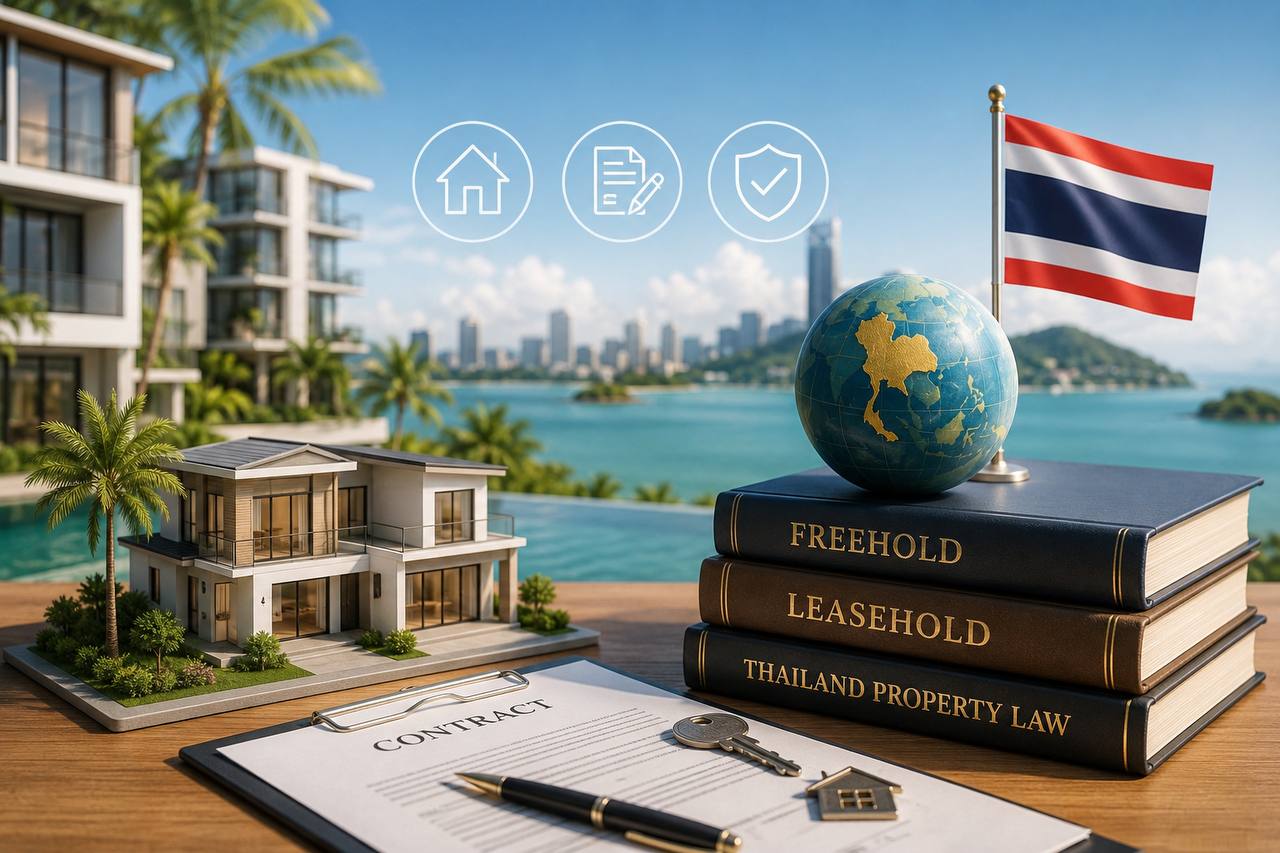
Short answer: yes, foreigners can buy property in Thailand — but not everything, and not in every form. A condominium unit can be owned outright, in your own name, forever — that's freehold. Land is different: foreigners cannot own land in Thailand, so the plot under a villa is held through a registered long-term lease (leasehold), while the house itself can be yours. Every legitimate property purchase in Thailand is built around this split.
This guide covers every legal ownership structure available to foreign buyers as of 2026 — including what changed after the Supreme Court ruling on the "30+30+30" lease scheme, why buying a villa through a Thai company went from "everyone does it" to a genuine legal risk, and the honest status of the reforms you keep reading about in the news.
The map: what a foreigner can buy in Thailand
What you're buying | Ownership form | In a foreigner's name? | Term |
Condo unit (within the foreign quota) | Freehold — full ownership | Yes, directly in your name | Indefinite |
Condo unit above the foreign quota | Leasehold — registered lease | Yes | Up to 30 years |
Villa / house (the building itself) | Ownership of the structure | Yes | Indefinite |
Land under a villa | Leasehold + superficies right | Yes, as a registered right | Up to 30 years |
Land as freehold | Narrow exceptions only (THB 40M investment) | In rare cases | — |
Freehold: owning a condo in Thailand outright
Freehold is full, permanent ownership — you can sell, gift, or pass the unit to your heirs. For foreign buyers it is available for exactly one property type: units in buildings legally registered as condominiums under the Condominium Act.
The 49% foreign quota. Foreigners collectively may own no more than 49% of the total unit floor area in any condominium building. If the quota in your chosen project is already full, freehold is off the table — you can only take that unit on leasehold. Quota availability should be verified before you pay anything.
Funds must come from abroad. To register foreign freehold ownership, the Land Department requires a Foreign Exchange Transaction (FET) certificate from a Thai bank — proof that your purchase funds were transferred into Thailand in foreign currency, marked for a condominium purchase. Paying cash you brought in, or from a Thai account without this paper trail, will block your registration.
"Condominium" is a legal status, not a marketing word. Apart-hotels and many buildings sold as "apartments" are not condominiums, and foreign freehold there is legally impossible — long lease only. Checking the building's legal status is question number one before any deposit.
On the rumored quota increase: a proposal to raise the foreign quota from 49% to 75% was floated and shelved. As of 2026 the quota remains 49%. Anyone selling you "the future 75%" as an argument is selling expectations, not law.
A note for UK buyers: Thai leasehold is not the leasehold you know from British flats. There is no 99- or 125-year term, no ground rent regime, and no statutory right to extend. The comparison that actually works is below.
Leasehold in Thailand: how it really works
Leasehold is not "almost ownership", whatever the sales brochure says. It is a long-term lease registered with the Land Department. It applies in two situations: condo units above the foreign quota, and — most importantly — land under villas.
30 years is the legal maximum. Thai law does not allow a longer registered term. What is registered is protected: if the landowner sells the land, your lease survives untouched until its end date.
The "30+30+30" scheme does not hold up in court. For decades the market sold "90 years of ownership": a 30-year lease with two pre-agreed automatic renewals. In March 2025 Thailand's Supreme Court ruled that such pre-written renewal chains are unenforceable. A renewal is always a new deal that the landowner — or their heirs — must agree to at the time. A clause in the contract does not bind them.
A lease over 3 years is void against third parties unless registered. If someone offers you a "long-term contract" that "doesn't need registering" — it is not a long-term contract.
Leasehold has a genuine upside too: on comparable units it typically prices 10–15% below freehold, and it is the only legal route to a house with land. The question is never "is leasehold bad" — it is whether yours is structured properly.
Buying a villa in Thailand: the house is yours, the land is leased
Foreigners buy villas in Thailand every day — but legally a villa purchase is not one transaction, it is a structure with two or three parts. Section 86 of the Land Code has banned foreign land ownership since 1954. The ban covers land — not buildings. So a properly structured deal looks like this:
The land goes on a registered 30-year leasehold.
The house is registered as your property, separately — the building permit and the sale agreement for the structure are issued in your name. The building is yours indefinitely.
Superficies — a registered right to own a building on someone else's land. In plain terms: even if something happens to the land lease, your right to the house is protected as a standalone registered right, not just a clause inside the lease.
In family situations (for example, buying while married to a Thai national) there is one more tool — usufruct: a lifetime right to live in and earn income from a property you don't own.
Watch the wording in listings. A "freehold villa" in Phuket almost always means freehold for a Thai buyer, or a company structure. As a foreign individual you cannot hold land freehold — an agent insisting otherwise is your cue to walk away.
Buying through a Thai company: why it's a bad idea in 2026
The classic grey scheme of past decades: set up a Thai company, put 51% in the names of Thai nominee shareholders, keep 49% yourself, and have the company buy the land. On paper a Thai entity owns it; in reality, you do.
This was always illegal — it just wasn't enforced. Since 2025, it is. Thai authorities launched an unprecedented crackdown on nominee structures: tens of thousands of companies flagged for investigation, real criminal prosecutions, police and the anti-money-laundering office working together, and automated registry analysis to detect the pattern. Draft amendments under discussion would allow the state to confiscate nominee-held land outright, instead of today's forced sale.
Bottom line: a nominee company to hold land is no longer "what everyone does" — it is a direct risk of losing both the money and the asset. A genuine Thai company with real business and real partners is a different story; as a vehicle to "own land for yourself", the corporate route is dead.
Can foreigners buy land in Thailand? The narrow exceptions
A flat "no" isn't quite precise. Exceptions exist, but they are narrow and rarely relevant to a regular home buyer:
Land for investment. With at least THB 40 million (≈ USD 1.1M) invested in government-approved assets — bonds, approved funds and projects — a foreigner may apply for personal permission to own up to 1 rai (1,600 m² / ~0.4 acre) for residential use. It requires the Interior Minister's approval, the investment must stay in place, and actual grants are vanishingly rare.
BOI-promoted companies and industrial estates may own land for their promoted business activity — this is about factories and offices, not your home.
Inheritance. A foreigner may inherit land in limited cases, but typically with an obligation to dispose of it — i.e., sell — within a set period.
Practical takeaway: plan your purchase around the two structures that work — a freehold condo, or a villa with the house owned and the land leased. Not around the exceptions.
"Thailand is about to let foreigners own land": the honest status
These headlines resurface every year. Here is where things actually stand in 2026:
99-year leasehold. A bill enabling ultra-long leases has been discussed for years — not passed.
75% condo quota. Proposed, criticized, shelved — the quota remains 49%.
Land sales to foreigners. In 2022 the government tabled a proposal letting wealthy investors buy up to 1 rai — and withdrew it after public backlash. The topic keeps returning to the news; the law hasn't changed.
The buyer's rule: decide based on the law as it stands, not on announcements. If reforms pass, owners of properly structured property only gain; if they don't, you lose nothing.
Financing, title insurance and other things Western buyers expect
Mortgages: mostly no. Thai banks rarely lend to non-resident foreigners. The market runs on cash and developer payment plans — for off-plan projects, interest-free installments through construction are standard. Budget accordingly.
Title insurance: doesn't exist here. Unlike the US, there is no title insurance industry in Thailand. Your protection is upfront due diligence: verifying the land title deed (a Chanote — the strongest form of Thai title document), the seller, encumbrances and permits before money moves. That check is not a formality to skip.
How this shapes your choice
Maximum simplicity and resale liquidity → a freehold condo within the 49% quota. Browse condos for sale in Phuket.
A house with land → villa: house owned + registered leasehold and superficies on the land, with the structure reviewed by an independent lawyer. Browse villas for sale in Phuket.
Offered a "freehold villa through a company" → decline, or have the structure dissected by independent counsel.
On DealsGrid, the ownership form is stated on every listing, and only verified agents and developers can publish — a "freehold" that hides a lease doesn't make it into the catalog.
What it costs and how the purchase works
Ownership form directly drives your closing costs: a freehold transfer carries a 2% transfer fee on the assessed value (customarily split with the seller), while registering a leasehold costs 1.1% of the total lease value. Resale deals add the seller's withholding taxes, which often get priced in. The full breakdown with worked examples is here: Taxes and Costs When Buying Property in Thailand
The purchase itself — from reservation and due diligence to registration at the Land Department — takes anywhere from two weeks to a couple of months, with fixed checkpoints along the way: Chanote title verification, the FET certificate, and safe payment structuring for off-plan purchases. The step-by-step walkthrough is here: Buying Property in Thailand: The Step-by-Step Process
FAQ
Can a foreigner buy a condo in Thailand in their own name?
Yes. A unit in a legally registered condominium can be owned freehold in a foreigner's name — provided the building's 49% foreign quota isn't full and the purchase funds came from abroad with an FET certificate from a Thai bank.
Can foreigners buy land in Thailand?
No, apart from narrow exceptions (a THB 40M approved investment). Land under a villa is held via a registered lease of up to 30 years plus a superficies right, while the house itself can be owned by the foreigner outright.
Is the 30+30+30 lease scheme legal?
The scheme — 30 years plus two pre-agreed automatic renewals, marketed as "90 years" — was ruled unenforceable by Thailand's Supreme Court in 2025. The legally guaranteed term is 30 years; any renewal is a new agreement requiring the landowner's consent at the time.
Freehold vs leasehold in Thailand — which is better?
Freehold means permanent ownership and stronger resale liquidity. Leasehold is typically 10–15% cheaper to buy and is the only legal route for land and for condos above the quota. All else equal, choose freehold for a condo; for a villa, leasehold on the land is market standard — what matters is how well it's structured.
Can I buy a villa through a Thai company?
Through a company with nominee shareholders — no, it's illegal, and since 2025 it is actively prosecuted: mass investigations, criminal cases, and proposed land confiscation rules. We advise against any "company for the land" setup.
Can property in Thailand be inherited?
A freehold condo — yes, it passes to heirs like any owned asset (the heir must fit within the foreign quota). Leasehold is trickier: succession of the lease must be explicitly written into the contract, otherwise the lease can end with the leaseholder's death.