
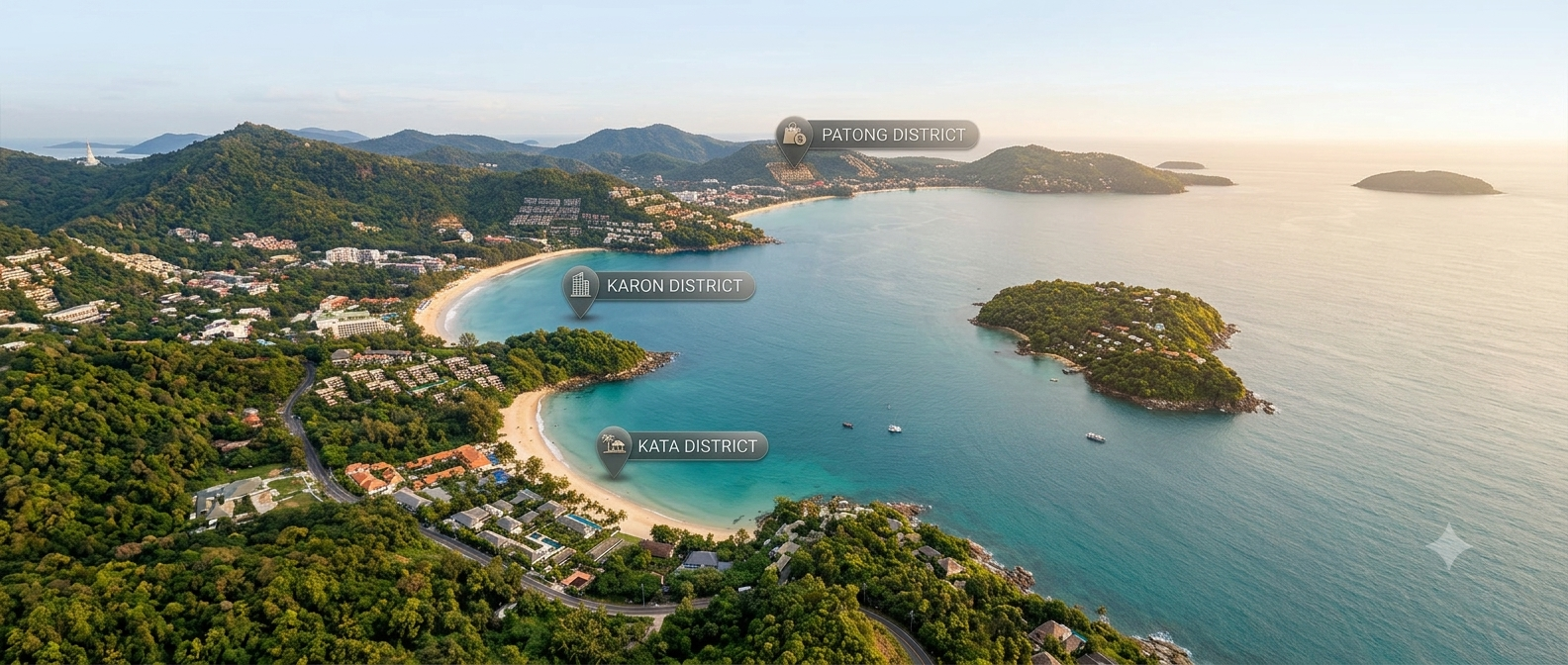
Short answer — by what you are buying for. Buying to earn on tourist rentals — the tourist west: Patong, Kata, Karon, Kamala (gross yields 6–8%; the best managed units reach 8.4% net). Buying a home for your family — Bang Tao and Laguna: international schools, healthcare, the island's most resilient premium demand. Wintering, or looking for the lowest entry budget — the south: Rawai and Nai Harn (condos from ~THB 55,000/m², but watch the supply pipeline). Betting on appreciation over 5 years — Chalong and the Phuket Town–Kathu corridor. The difference between areas isn't "which beach is nicer" — it's hundreds of thousands of baht per square meter and full percentage points of annual yield: prices vary up to threefold between zones, and the same unit's occupancy differs by half between January and June. Below, every area in two dimensions — for living and for money — with price benchmarks, occupancy data and links to current supply.
How to use this guide: (1) pick your task from the four above; (2) take the 2–3 areas of your scenario from the breakdowns below — each comes with prices, occupancy and risks; (3) follow the area links to specific projects: the outcome is always decided by the project and its management — the area only sets the frame.
The Phuket Market in Numbers
Metric (2025 — early 2026) | Value |
Tourism recovery vs 2019 | ~97.5% (4.16M international arrivals Jan–Oct 2025) |
Top source market | Russia (~833K), then India and China |
Hotel occupancy: high-season peak | 91.8% (January); Jan–Apr consistently above 81% |
Hotel occupancy: low-season trough | 66.9% (June) |
Median condo price | ~THB 135,000–144,000/m² (quality band: 100,000–180,000) |
Price growth, last 12 months | ~+2% nominal — the market has shifted to selective growth |
Median long-term rent (mass segment) | ~THB 35,000/month |
Gross short-term rental yield | 6–8% on the west coast; 4–5% on the east |
Benchmarks compiled from industry reports and market publications (C9 Hotelworks, Knight Frank, CBRE, Phuket Tourist Association), late 2025 — H1 2026. Prices and yields vary by project and unit; treat as a frame, not an offer.
Two takeaways before the area breakdown. First: the market has left its "everything sells" phase — price growth has slowed to ~2% a year, and demand concentrates in specific projects with strong locations and management; liquidity is now a property of the project, not the island. Second: seasonality is not an abstraction but a real cash-flow gap — the island slides from 91.8% occupancy in January to 66.9% in June. Any rental model that multiplies high-season rates by 12 months is fiction.
Geography in a Minute
The island runs ~50 km north to south; everything of interest to buyers sits on the west coast and in the south. The east is marinas, Cape Panwa and local life; the center is service districts without the beach premium; the north by the airport is national park and a thin market. Neighboring areas are 10–20 minutes apart by car. The legal frame of the choice (freehold condo vs villa structure) is covered in the guide to property ownership for foreigners.
Bang Tao, Laguna and Choeng Thale: the Premium Core
A six-kilometer beach, Laguna golf, beach clubs, Boat Avenue and Porto de Phuket retail — the island's most complete environment. The center of gravity of premium demand has shifted here: branded residences, beachside condos, gated villa estates.
For living: the island's best school logistics — international schools (UWC Thailand, HeadStart Cherngtalay, British International School in Koh Kaew) within 10–25 minutes; clinics, Villa Market supermarkets, full daily infrastructure without leaving the area. The minus: premium pricing on everything, and rush-hour traffic around Boat Avenue.
For investment: condos benchmark at THB 130,000–200,000/m², branded projects above; the island's strongest long-term rates and a premium short-term ticket. A telling fact about demand concentration: a single villa project in Choeng Thale drew nearly a quarter of all island-wide enquiries in the THB 30M+ segment — premium liquidity here is address-specific; buyers buy a project, not "an area".
Browse the supply: all Bang Tao property, listings in Laguna, Bang Tao projects under construction and the whole administrative district — Choeng Thale.
Layan: Scarcity-Priced Premium by the Park
The north end of Bang Tao beach at the border of Sirinat National Park: greenery, calm water, low-rise. The market is mostly villas and among the island's most expensive — and the park border is exactly what keeps it scarce: large-scale new development has nowhere to land, which has historically supported prices. For living — privacy ten minutes from Bang Tao's infrastructure; for investment — capital preservation in the villa segment rather than rental cash flow. Current villas and condos — in the Layan selection.
Surin: a Small Market with Resilient Prices
A compact, prestigious beach between Bang Tao and Kamala: some of the island's most expensive villas on the hills, a modest condo pool below (benchmark ~THB 120,000–180,000/m²) and walkable dining. The key investment trait Surin shares with neighboring Kamala is restrained new supply: there is almost nowhere left to build, so prices have historically held better than in areas with a construction conveyor. It's a small market — choice is limited, but resale doesn't drown in competitors either. What's on the market now — Surin listings.
Kamala: the Live-and-Let Balance
A wide, calm bay ten minutes from Patong with the opposite temperament: a beachfront walk, an unhurried pace, a family environment. The northern headland carries the villa "Millionaire's Mile"; the area itself runs an active mid-to-upper-mid condo market.
For living: its own daily infrastructure (markets, supermarkets, clinics), Choeng Thale schools 15–20 minutes away; of all the "tourist" areas, Kamala is the most residential.
For investment: condos benchmark at ~THB 110,000–160,000/m². Rental demand feeds off Patong's proximity minus the noise, while supply is constrained by the terrain — market analysts rank Kamala with Surin among the zones least likely to see prices fall. The working strategy is mixed letting: short-term in season, mid-term off-season.
Selections: Kamala property and separately the area's new developments.
Patong and Kalim: the Short-Term Rental Machine
Patong is the tourist capital: the main beach, Bangla Road, the Jungceylon mall, maximum density of everything. Living here is an acquired taste; earning here is a profession.
For investment: the island's deepest short-term market — occupancy is easiest to sustain, including off-season on residual tourist flow. The flip side: the fiercest unit-level competition and the widest spread in project quality; prices benchmark at THB 90,000–140,000/m², and nowhere does management decide the outcome more than here. It's on Patong-type demand that professionally managed portfolios post 72–78% annualized occupancy and ~7.8–8.4% net yields — versus the "average 6–8% gross" of self-managed letting.
Kalim is the quiet neighbor on the northern exit: sunset views, low-rise stock, five minutes to Patong's infrastructure without living above a bar. Pricing runs at Patong level or slightly below; it suits buyers who want Patong's rental demand without Patong's soundtrack.
On the market: Patong listings · quiet Kalim next door.
Karon: a Big Beach at a Mid Ticket
The island's second-longest beach, a clear step calmer than Patong ten minutes away. Mixed tourist and residential stock; condos benchmark at THB 80,000–120,000/m², with up to a threefold spread inside the area between the beachfront and the hills — the classic "beach west at a reasonable budget" entry point. Rentals are steady family-tourist demand without Patong's peaks or Patong's competition. Browse what's for sale in Karon.
Kata and Kata Noi: Demand in Both Seasons
A compact, active area with one of the island's most photogenic beaches; neighboring Kata Noi is a smaller, noticeably quieter bay with a premium beachfront line. Kata's unique trait for rental math: in the low season it becomes the island's surfing hub, so demand doesn't switch off in summer — a west-coast rarity that smooths that June trough. Condos benchmark at THB 90,000–140,000/m²; Kata Noi by the water runs higher. Selections: Kata property · the Kata Noi beachfront.
Rawai and Nai Harn: the South for Living — with an Investor's Caveat
Residential Phuket rather than tourist Phuket: Rawai's waterfront of longtail boats and its seafood market, cafés and coworking spaces, an international long-stay community; swimming happens at neighboring Nai Harn, the south's best beach.
For living: the friendliest cost of living among the coastal areas, the south's own schools and clinics nearby (including international school campuses in the Rawai–Chalong zone), 10–15 minutes to Chalong's full service infrastructure. This is the winterers' heartland — and the island's median ~THB 35,000/month long-term rent is made largely here.
For investment — run the sober math: entry is low (new condos benchmark at THB 55,000–70,000/m², i.e. a studio at ~THB 1.8–2.1M), and the budget segment's 7–8% gross yield looks attractive — but occupancy swings from 80–90% in season to 40–55% off-season, and the main risk is supply: 1,200+ new units are coming into the south's budget segment, so competition for tenants will grow. Buy here for your own living or long-term letting; for short-term, only hand-picked projects.
Current stock: the Rawai supply · listings by Nai Harn beach.
Chalong, Kathu and Phuket Town: the Island's Value Belt
Areas without a beach — and therefore without the beach premium: entry benchmarks from THB 50,000–80,000/m². Chalong is the south's service capital: the marina and pier (launch point for island trips), schools, clinics, Muay Thai gyms, hypermarkets; Kathu is the island's center with British International School nearby and Patong 15 minutes away; Phuket Town is the old town — coffee culture, public infrastructure and the most genuinely urban rhythm on the island. The belt's investment logic: analysts call the Phuket Town–Chalong corridor the island's most compelling price-per-meter entry with the highest 5-year upside — paired with higher risk: short-term rentals barely exist here, so the play is long-term letting plus appreciation as the island develops. Browse: Chalong listings · Kathu · Phuket Town.
East and North: Cape Panwa, Thalang and the Airport Areas
The east coast means calm water year-round (unlike the west's off-season surf), marinas and seclusion: Cape Panwa is an intimate resort peninsula; east-side short-term yields are modest — a 4–5% gross benchmark — but it's the best "quiet by the water" living option. The north by the airport — Nai Yang, Nai Thon, Mai Khao — is capped by Sirinat National Park: no large-scale development, a thin market, few transactions; it's a seclusion-and-long-horizon choice, not a cash-flow one. Inland Thalang is a growing residential zone next to the Choeng Thale schools. Selections: Cape Panwa · Nai Yang · Nai Thon · Mai Khao · Thalang.
What's Being Built on Phuket — and What It Means for Prices
The island is entering the largest infrastructure cycle in its history: transport megaprojects worth tens of billions of baht have cleared key approvals and sit in the 2026 budget lists. For a buyer this is a map of future area re-ratings — with a mandatory adjustment for Thai timelines.
The Kathu–Patong tunnel and expressway (3.98 km, a 1.85 km tunnel under the Nakkerd range, ~THB 16–17bn): construction start slated for 2026, opening targeted 2029–2030; the project was recently re-engineered (tunnel narrowed to two lanes) and proposed toll-free. Direct beneficiaries — Kathu (from "the area behind the mountain" to 5–7 minutes from Patong) and Patong itself, whose logistics stop depending on the mountain switchbacks.
The Muang Mai–Koh Kaew–Kathu expressway (30.6 km, ~THB 47bn): phase two of the same axis, approval targeted in 2026, completion around 2029–2031. Combined with the tunnel it forms a continuous 35 km "airport → Patong in ~20 minutes" artery. Beneficiaries — the whole Koh Kaew/Thalang corridor and the northwest, whose airport accessibility jumps.
The airport–Chalong light rail (LRT): per the MRTA's latest decision, construction from 2028, launch in 2031. Honestly: the project has been postponed for twenty years, and it must not be priced into a purchase. If it happens, the long-term beneficiaries are Chalong (the terminus) and the Phuket Town corridor along the route.
The airport: expansion from 12.5 to 18 million passengers a year by ~2029 — a direct driver of rental demand for the whole island, regardless of the other projects' fate.
Reality adjustment: the February 2026 election has slowed approvals of long-term budgets, and the tunnel's history spans 20+ years of postponements. The buyer's rule: pay for the area's value today; infrastructure is a free option on top, not the base case.
Outlook and ROI: How to Model Total Return
Total property return = rental income + appreciation at exit. They must be modeled separately — and on Phuket they are distributed across areas differently:
Rent (cash flow). The west's 6–8% gross becomes 4–6% net when self-managed (minus management, utilities, voids, wear); professional management on deep tourist flow reaches 7.8–8.4% net at 72–78% occupancy — the market's upper bound, achievable with the right unit and the right operator. A rough payback benchmark on net rent: 12–17 years.
Appreciation. The market is in a selective-growth phase: ~+2% a year island-wide, +35–55% nominal over a decade — but it isn't "the island on average" that appreciates; it's scarce locations and strong projects.
The Bang Tao scarcity thesis. The premium northwest's land is physically constrained: the national park to the north (Layan), the Laguna estate occupying the center, a built-out beachfront — new projects retreat inland from the sea. Supply-constrained zones (Bang Tao, Surin, Kamala) have historically shown the best price resilience, and it is reasonable to expect them to keep outperforming. That is a probability grounded in supply mechanics — not a guarantee.
The value belt's asymmetry. Kathu is the decade's prime re-rating candidate: entry from ~THB 50–80K/m² against a future 5–7 minutes to Patong through the tunnel. Chalong adds the LRT-terminus option. The belt's formula: lower rent today — higher appreciation option tomorrow — higher timeline risk.
The south: nominal rent is high, but price growth will be capped by the 1,200+ unit pipeline — buying here makes sense for your own living and long-term letting, not for speculative appreciation.
A 5-year ROI frame (a benchmark, not an offer): a quality west/northwest project — total return in the order of 6–10% a year, and above for the best scarce-location-plus-strong-operator combinations (4–6% net rent, up to 8.4% under professional management, plus selective appreciation); the value belt — less cash flow now, more upside later; the budget south — higher nominal cash flow, lower predictability. This material is informational and not investment advice.
Summary Table: Prices, Rentals, Liquidity
Area | Condo THB/m² (benchmark) | Short-term rentals | Liquidity & dynamics | Best for |
Bang Tao / Laguna / Choeng Thale | 130,000–200,000+, branded above | Strong year-round, premium rates | Island's deepest premium demand; price resilience | Families, premium investment |
Layan | Premium; mostly a villa market | Premium villas, high ticket | Supply constrained by the national park | Privacy, capital preservation |
Surin | ~120,000–180,000 | Limited volume | Restrained new supply → resilience | Quiet next to premium |
Kamala | ~110,000–160,000 | Good: Patong nearby, minus the noise | Constrained supply → price stability | Families + mixed rentals |
Patong | ~90,000–140,000 | Island's deepest market; fiercest competition | Highest turnover, wide quality spread | Short-term rental investors |
Karon | ~80,000–120,000 | Steady family-tourist demand | Mid; competitive price segment | Families, mid budgets |
Kata / Kata Noi | ~90,000–140,000; Kata Noi beachfront higher | Two seasons of demand (summer surf) | Good in the condo segment | Rentals across both seasons |
Rawai / Nai Harn | from ~55,000–70,000 in new projects | Gross 7–8%; occupancy 80–90% HS / 40–55% LS | Risk: 1,200+ new budget units in the pipeline | Living, wintering, budget entry |
Chalong / Kathu / Phuket Town | from ~50,000–80,000 | Weak short-term; long-term play | Value belt: higher risk, higher 5-yr upside | Living on a rational budget |
North (Nai Yang / Nai Thon / Mai Khao) | Mid segment; supply capped by the park | Niche: airport and seclusion | Thin market, few transactions | Quiet, long horizon |
Prices are condo benchmarks for early 2026; villas price differently (land, title, ownership structure). Yields are gross, before management, utilities and taxes.
How to Choose: Three Scenarios with Numbers
Short-term rental investment. Start from depth of tourist flow: Patong, Kata, Karon, Kamala. Then the project and management decide: the gap between self-managed letting (6–8% gross) and professional management (72–78% occupancy, ~8% net) is the real yield fork. The full economics with the cost side — in the guide to Phuket property rental yields.
Family living. Bang Tao/Laguna for schools and environment; Kamala and Thalang are calmer and cheaper with the same schools 15–20 minutes away; Chalong is the rational budget with the south's full services.
Wintering and long stays. Rawai/Nai Harn for community and cost of living; the east (Cape Panwa) if calm water year-round matters. Long-term-focused investors look here too — occupancy stability over peak rates.
Mistakes When Choosing an Area
Modeling rent on high season. The island-wide occupancy gap between January and June is 25 percentage points; in the budget south it's up to twofold. An honest model runs 12 months on the real seasonal curve.
Buying "an area" instead of a project. Phuket demand concentrates address by address — to the point where one project captures a quarter of an entire price segment's enquiries. Resale liquidity will be decided by the project, management and unit; the area only sets the frame.
Ignoring the supply pipeline. 1,200+ units are being built in the south's budget segment — today's yields are getting competitors. Before buying, check what's launching nearby over the next 2–3 years.
Choosing by your holiday and the renders. Visit your shortlist in both seasons or rent for a month; test distances in traffic, not on the map. And keep the priority order — legal before the view: how the deal runs and what it costs in taxes and fees.
Looking beyond Phuket
Phuket is Thailand's most liquid resort market, but not the only strategy. Pattaya offers a lower entry and Bangkok two hours away; Samui is an intimate island with a growing premium tier; Krabi is an early-stage market with headline nature; Koh Phangan is a niche long-stay island. Verified listings across all of them: Pattaya · Samui · Krabi · Koh Phangan. Dedicated guides to these markets are on the section's roadmap.
FAQ
Which Phuket area is best for rental investment?
For short-term — the peak-flow areas: Patong, Kata, Karon, Kamala; west-coast gross yields run 6–8%, and professional management pushes net to ~8% at 72–78% occupancy. For premium long-term — Bang Tao and Laguna. The project and its management decide as much as the area.
Where are Phuket's highest yields?
Nominally the budget south: Rawai posts 7–8% gross on a low entry. Adjusted for seasonality (40–55% off-season occupancy) and 1,200+ competing units in the pipeline, the deep-flow west with professional management looks more durable.
Where is the best place in Phuket for families?
Most often Bang Tao/Laguna: international schools (UWC, HeadStart, BISP) within 10–25 minutes, healthcare, environment. Calmer and cheaper — Kamala and Thalang; budget-rational — Chalong with the south's full services.
What is the cheapest Phuket area to buy in?
The no-beach-premium belt — Chalong, Kathu, Phuket Town (benchmarks from THB 50,000–80,000/m²) and the budget south — Rawai/Nai Harn (new condos from ~55,000–70,000/m²). For context: the island's median is ~135,000–144,000, the premium northwest 130,000–200,000+.
What budget do I need to enter?
The market's entry point is studios in the south and the value belt: ~THB 1.8–2.1M (55,000–70,000/m² in new Rawai projects). The mid west (Karon, Kata): one-bedrooms from ~THB 3–5M. The premium northwest: condos from ~THB 5–8M at 130,000–200,000/m², villas from ~THB 20–30M. Add 2.5–6.3% transaction costs on top.
Are Phuket property prices rising?
About +2% nominal over the last year: the market has moved from the post-Covid boom to selective growth, where projects with strong locations, brands and management appreciate first. Over ten years, nominal growth is estimated at +35–55%.
How will the new infrastructure affect prices?
The Kathu–Patong tunnel (opening targeted 2029–2030) and the airport expressway will re-rate Kathu and the Koh Kaew/Thalang corridor most; the airport's expansion to 18M passengers supports rental demand island-wide. The light rail (construction from 2028, launch 2031 on the current plan) is too early to price in — the project has slipped for twenty years. Buy the area's value today; infrastructure is the option on top.
Bang Tao or Rawai — which one?
A strategy choice. Bang Tao: premium environment, schools, the most resilient demand at THB 130,000–200,000+/m². Rawai: southern living, entry from ~55,000/m² and high nominal yields — with off-season occupancy dips and growing new-build competition. Investors lean northwest; winterers lean south.